The AI Trap: When Defense Counsel Starts Questioning Your Experts
It’s a Tuesday morning. You’re sitting in a cramped deposition room. Your expert witness, a brilliant orthopedic surgeon, is being grilled. But the defense counsel isn’t asking about the plaintiff’s disc herniation.
Instead, they ask: “Doctor, did you use a Large Language Model to synthesize the medical literature cited in Section 4? Can you produce the specific prompts you used?”
Welcome to the AI Trap.
Mandatory Certifications
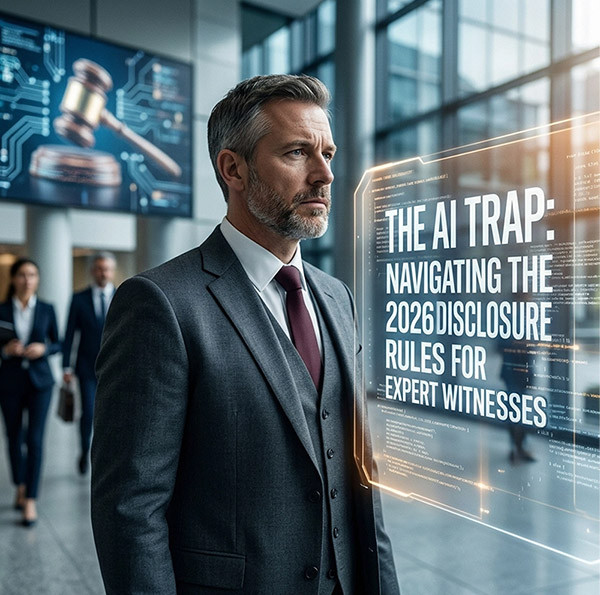
The “wild west” era of AI is over. Today, we are operating in a world defined by over 300 new rules and judicial mandates specifically targeting the use of Artificial Intelligence in the courtroom. Let’s be real: Defense counsel has always looked for ways to strike your experts. Whether it’s a Daubert challenge or a nitpicky conflict of interest, their goal is to leave your case toothless before it ever hits a jury. The “AI Trap” is becoming their favorite strategy.
The trap is simple: Defense attorneys are now scrutinizing expert reports not just for scientific validity, but for “digital integrity.” They are looking for any sign that an expert used AI to draft, analyze, or even cite sources without explicit disclosure. For the defense, these rules aren’t just administrative hurdles, they are a brand-new arsenal.
Two of Florida’s largest judicial circuits have implemented mandatory AI certifications. You must certify the process, not just check the work. Defense counsel looks for any lack of transparency here to file a motion to strike.
The Northern District of Texas (N.D. Tex. Civ. R. 7.2(f)) and the Eastern District of Pennsylvania (Standing Order Re: Artificial Intelligence in Cases Assigned to Judge Scott)now require affirmative certification. You can’t just stay quiet and hope no one asks. Experts must now:
- Identify the specific tool: You can’t just say “AI software.” You must name names: ChatGPT-5, Claude 4, or specialized legal LLMs.
- Describe the scope: Which sections were AI-assisted? Was it just for data sorting, or did the AI help formulate the causation opinion?
- Certify Human Verification: This is the big one. The expert must swear, under penalty of perjury, that every single citation and statement was verified by a human being.
The “Heppner” Nightmare
The Southern District of New York (SDNY) ruling in U.S. v. Heppner(February 2026) ruled that AI prompts entered into public platforms are not privileged. While this was a criminal case, it’s not hard to see it soon being pushed by personal injury defense counsel. It makes me think of the Simpson’s character Monty Burns steepling his fingers and saying “excellent.” Imagine the defense getting their hands on prompts like: “Summarize these records to emphasize the permanency of the injury.” It makes a legitimate expert look like a hired gun.
The Credibility Gap
Defense attorneys are trained to spot “AI-speak.” A single “hallucination” in a report is a one-way ticket to striking the pleading or sanctions. Verification takes time and money.
Human Oversight: The 2026 Gold Standard
In today’s climate, a “bulletproof” expert isn’t just someone with a PhD and thirty years of experience. It’s someone who treats AI like a powerful, but incredibly untrustworthy, junior associate.
The gold standard for expert reports going forward is Human Oversight. This means the expert must be able to demonstrate a clear “paper trail” of how they arrived at their conclusion independent of the AI. If the AI suggested a methodology, the expert must show how they verified that methodology against peer-reviewed standards.
The fact is the tech is moving faster than the law, but the law is finally catching up with a heavy hand. You can’t afford to have an expert who is “winging it” with new tech.

Why Premium Experts Cost More (And Why It’s Worth It)
Here is the hard truth for plaintiff’s attorneys: The experts who actually understand these 2026 disclosure rules: the ones who have hired their own technical consultants to ensure their workflow is “trap-proof”: are expensive.
High-tier experts in catastrophic injury cases, neurology, or complex engineering are charging a premium for the extra hours of manual verification required to meet these new judicial standards. You might be looking at a 20-30% increase in expert fees just to cover the “AI Compliance” aspect of a report.
This is where many under-capitalized firms fall into a different kind of trap. Big Insurance leverages your financial need to force you into using an “AI-reliant” budget expert who uses AI to save time and keep costs down, only to have that expert struck 30 days before trial because they didn’t disclose their use of a drafting tool.
How HMR Servicing Bridges the Gap
At HMR Servicing, we’ve seen this play out for over 13 years. We’ve funded over $250 million in cases, focusing specifically on catastrophic injuries where the stakes are the highest. We know that in 2026, you can’t win a “David-vs-Goliath” battle if your “David” gets disqualified on a technicality.
We provide the financial bridge that allows you to hire the top-tier experts who know how to navigate these technical and legal traps. We don’t just fund your case; we help you level the playing field against insurance companies that have bottomless pockets for their own “AI-compliance” defense teams. Don’t let a machine lose your case.

The HMR Edge:
- 13+ Years of Experience: We’ve seen every defense tactic in the book, from the early Daubert days to the modern AI Trap.
- $250M+ Funded: Our track record speaks for itself. We have the liquidity to support your most complex, high-stakes cases.
- Focus on Catastrophic Cases: We understand the unique needs of brain injury, spinal cord injury, and wrongful death litigation.
- Speed and Transparency: We know trial dates don’t wait. Our funding process is designed to be as fast as it is thorough.
Don’t Let Your Case Be a Test Case
The AI disclosure rules are still being interpreted by the courts. You do not want your $10 million catastrophic injury case to be the “test case” for a new AI-related sanctions rule.
The solution is simple:
- Vet your experts on their AI usage and disclosure protocols before you retain them.
- Demand “Human Oversight” as a line item in their report preparation.
- Secure the funding necessary to hire the best, most compliant experts in the field.
Plain and simple, Big Insurance is hoping you’ll cut corners. They are betting that you won’t have the capital to fight the “AI Trap.” Don’t prove them right.
If you’re ready to put together the best case possible without the stress of expert costs, let’s talk. Whether you’re in New York, California, or anywhere in-between, HMR Servicing is here to help you navigate the future of litigation.
Ready to level the playing field?
Contact HMR Servicing today and find out how our line-of-credit and case cost solutions can protect your firm from the AI Trap. You focus on the law; we’ll focus on the fuel to get you to the finish line.